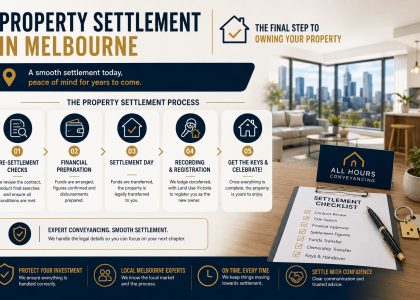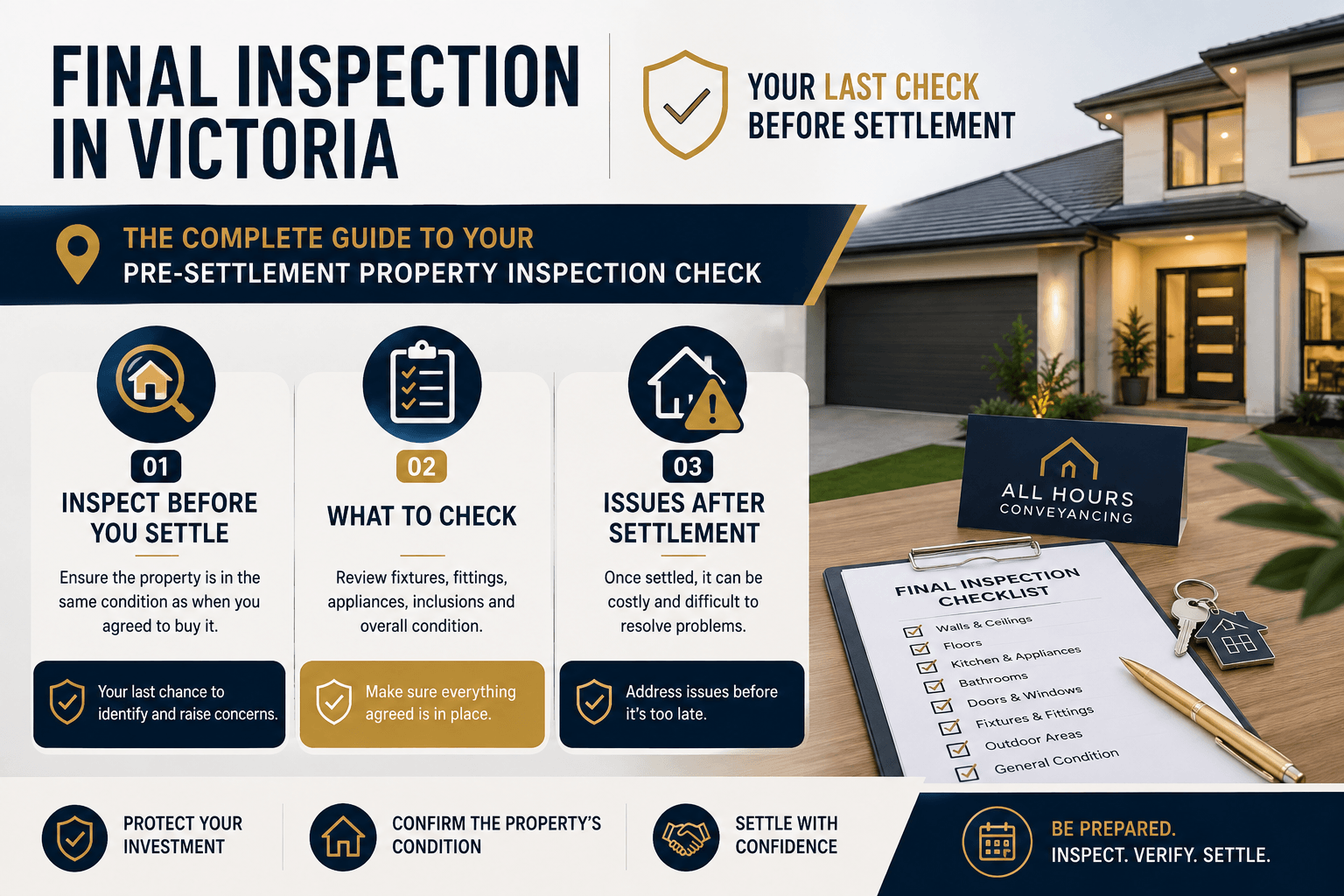
Your final inspection in Victoria stands between you and property ownership. This single walkthrough determines whether the home matches what you agreed to purchase. Skipping it or rushing through it exposes you to costly post-settlement disputes that your conveyancer cannot easily reverse.
You will find your legal rights under Victorian contracts, a complete property settlement checklist, and clear escalation steps if problems surface.
All Hours Conveyancing has guided more than thousands of property transactions over 20 years since 2005, holds a 4.8 star rating from 129 Google reviews, and is led by Shakila Maclean, President of the Australian Institute of Conveyancers (Victorian Division).
Pre-Settlement Inspection Timing and Rights in Victoria
Schedule your pre-settlement inspection at a reasonable time in the seven days before settlement, ideally after the vendor has moved out so you can see the true condition of the property.
Legal Rights and Timing Under Victorian Contracts
General Condition 29 of the standard Victorian contract of sale establishes your right to inspect. This clause requires the vendor to deliver the property in substantially the same condition as at the date of sale, excluding fair wear and tear. A licensed conveyancer reviews this clause alongside any special conditions before your inspection. The Consumer Affairs Victoria guidance on pre-settlement inspections confirms buyers are entitled to inspect at any reasonable time in the week before settlement.
Your legal recourse depends on what the contract specifies. If the property settlement inspection reveals a breach, you can request repairs, seek compensation, or in serious cases delay settlement. Victorian contract obligations place the burden on the vendor to maintain the property condition between exchange and settlement. Key rights include:
- One inspection at a reasonable time in the seven days before settlement
- The right to compare current condition against the contract date condition
- The ability to raise defects formally through your conveyancer before settlement proceeds
Keep in mind that the property is sold in the condition it was in at the contract date, excluding fair wear and tear. Your final inspection is about confirming nothing has changed since then, not about raising defects that existed when you signed.
Check the Property's Agreed Condition
Walk every room and compare it against the state you observed at contract signing. If a ceiling had no water stains at contract date but now shows brown discolouration, this constitutes new damage. Bring photos from your earlier visits for direct comparison. Take video as well as photos so you have a clear, time-stamped record of the property’s condition.
Verify Any Agreed Repairs Are Complete
Cross-reference your inspection repairs checklist against the contract special conditions. If the vendor agreed to fix a leaking shower or replace a broken window, test the repair yourself. Run the shower for two minutes and check for leaks beneath.
Pre-Settlement Inspection Checklist (Final Inspection Before Settlement Victoria)
Use this final inspection checklist Victoria to systematically cover every area of the property. Check off each item on-site rather than relying on memory after you leave.
- Appliances and fixtures: Test the oven, dishwasher, cooktop, and rangehood. Confirm all light fittings, curtain rods, and shelving listed in the contract remain in place and undamaged.
- Plumbing and water systems: Run every tap, flush each toilet, and test all showers. Check under sinks for active leaks. A first home buyer often overlooks the hot water system. Verify it delivers hot water within 30 seconds.
- Electrical and heating: Switch on every light, test power points with a phone charger, and run the air conditioner and heater. Confirm the electrical panel shows no tripped circuits.
- Smoke alarms and safety: Press the test button on every smoke alarm. Victorian regulations require working smoke alarms on every level. Missing or non-functional alarms represent a compliance gap the vendor must address.
- Windows, doors, and security: Open, close, and lock every window and door. Check sliding doors for smooth operation. Inspect garage doors and any automated openers for correct function.
What If There Is a Problem at Final Inspection?
Problems at the final inspection before settlement Victoria require immediate action. Document every defect with dated, timestamped photos. Contact your conveyancer the same day to formally notify the vendor’s legal representative. A verbal mention to the agent does not constitute formal notice under Victorian contract clauses.
Your escalation options depend on the severity of the issue. For minor defects like a broken towel rail, your conveyancer can negotiate a financial adjustment at settlement. For significant problems such as water damage or missing contracted inclusions, you can pursue one of these paths:
- Delay settlement until the vendor completes repairs (only on your conveyancer’s advice, as delaying settlement without a legal basis can put you in breach of contract)
- Negotiate financial compensation deducted from the settlement amount
- Withhold funds in trust pending resolution, with legal advice
- Issue a formal breach notice through your conveyancer if the vendor refuses to act
Frequent Problems Found at Pre-Settlement Inspections
Conveyancing practitioners across Victoria encounter these final inspection red flags repeatedly.
- Move-out wall and floor damage: Scratched floorboards, dented plasterboard, and chipped tiles from furniture removal. Compare against your contract-date photos to confirm the damage is new.
- Missing contracted inclusions: Dishwashers, window blinds, ceiling fans, or garden sheds listed in the contract but removed by the vendor before settlement.
- Incomplete or substandard repairs: Patch jobs that do not match the original finish. A vendor could paint over a wall crack rather than properly fill and sand it.
- Unclean property: Grease-caked ovens, mouldy bathroom tiles, and rubbish left in garages. The contract requires the property in a clean and tenantable state, except for fair wear and tear.
- Non-functioning services: Gas, water, or electricity disconnected before settlement. The contract of sale typically requires all services to remain connected and operational, except for fair wear and tear.
Choosing Trusted Conveyancing Services Across Victoria
A conveyancing firm Victoria buyers can rely on makes the difference between a smooth settlement and a protracted dispute. All Hours Conveyancing has operated in Melbourne since 2005, providing contract review, pre-settlement inspection coordination, and formal defect escalation.
With more than 10,000 transactions guided, a 4.8 star rating from 129 Google reviews, and leadership by Australian Institute of Conveyancers (VIC) President Shakila Maclean, buyers across Victoria can rely on their experience.
For instance, if your final inspection reveals missing inclusions, their licensed conveyancers issue a formal notice to the vendor’s representative and negotiate a settlement adjustment on your behalf. Buyers can request a personalised fee proposal for their transaction.
Frequently Asked Questions
When can a final inspection be conducted in Victoria?
You can inspect the property at any reasonable time during the seven days before settlement. Your conveyancer or real estate agent arranges access with the vendor. Schedule as close to settlement day as practical to reduce the risk of new damage occurring between your inspection and ownership transfer.
What happens if I find damage or missing inclusions at final inspection?
Your conveyancer can negotiate a price reduction, request urgent repairs, or arrange to hold funds in trust. Photograph every issue with a timestamp and notify your conveyancer immediately so they can issue a formal notice to the vendor’s legal representative.
Do I need to be there for final inspection?
Attending in person is highly recommended, ideally after the vendor has removed all belongings and cleaned the property. Conduct your own independent walkthrough and take photos of every room, appliance, and outdoor area for your records.
What do they check in final inspection?
The final inspection confirms the property remains in the same condition as at contract exchange. Key checks include structural integrity, cleanliness, working fixtures, smoke alarms, plumbing, electrical systems, and all inclusions listed in the contract.
What should I bring to a pre-settlement inspection?
Bring your signed contract of sale, a printed checklist of all fixtures and inclusions, photos from your earlier inspections, and a phone for documenting issues.
Who should attend the final inspection?
The buyer and the real estate agent should attend. A second pair of eyes catches details you could miss. Bring a trusted friend or family member who can check separate rooms at the same time.
Can the vendor refuse access for a final inspection?
No. Under the standard Victorian contract of sale, the vendor must provide reasonable access for the buyer to inspect the property in the week before settlement. Refusing access constitutes a breach of contract, and your conveyancer can escalate the matter formally.
What is a pre-settlement inspection?
A pre-settlement inspection, also called a final inspection, is your walk-through of the property in the week before settlement. It confirms the home is in the same condition as when you signed the contract, that any agreed repairs are done, and that all contracted inclusions are still in place.
Is a pre-settlement inspection mandatory in Victoria?
No. A pre-settlement inspection is not legally required, but it is strongly recommended. It is your last opportunity to raise any issues while you still have negotiating power, before ownership transfers and the property becomes your responsibility.
Concluding Words
Your final inspection in Victoria is the last safeguard before property ownership transfers. A thorough walkthrough, combined with professional conveyancing support, protects you from post-settlement disputes that are difficult and costly to resolve. Take these steps to complete your inspection with confidence:
- Bring your contract, checklist, and comparison photos to every walkthrough
- Document defects with timestamped photos and notify your conveyancer immediately
- Contact All Hours Conveyancing to coordinate your pre-settlement inspection and receive professional guidance on any defects before settlement day
A structured approach to your final checklist and early professional involvement give you the strongest position at settlement. Do not leave your property investment to chance.