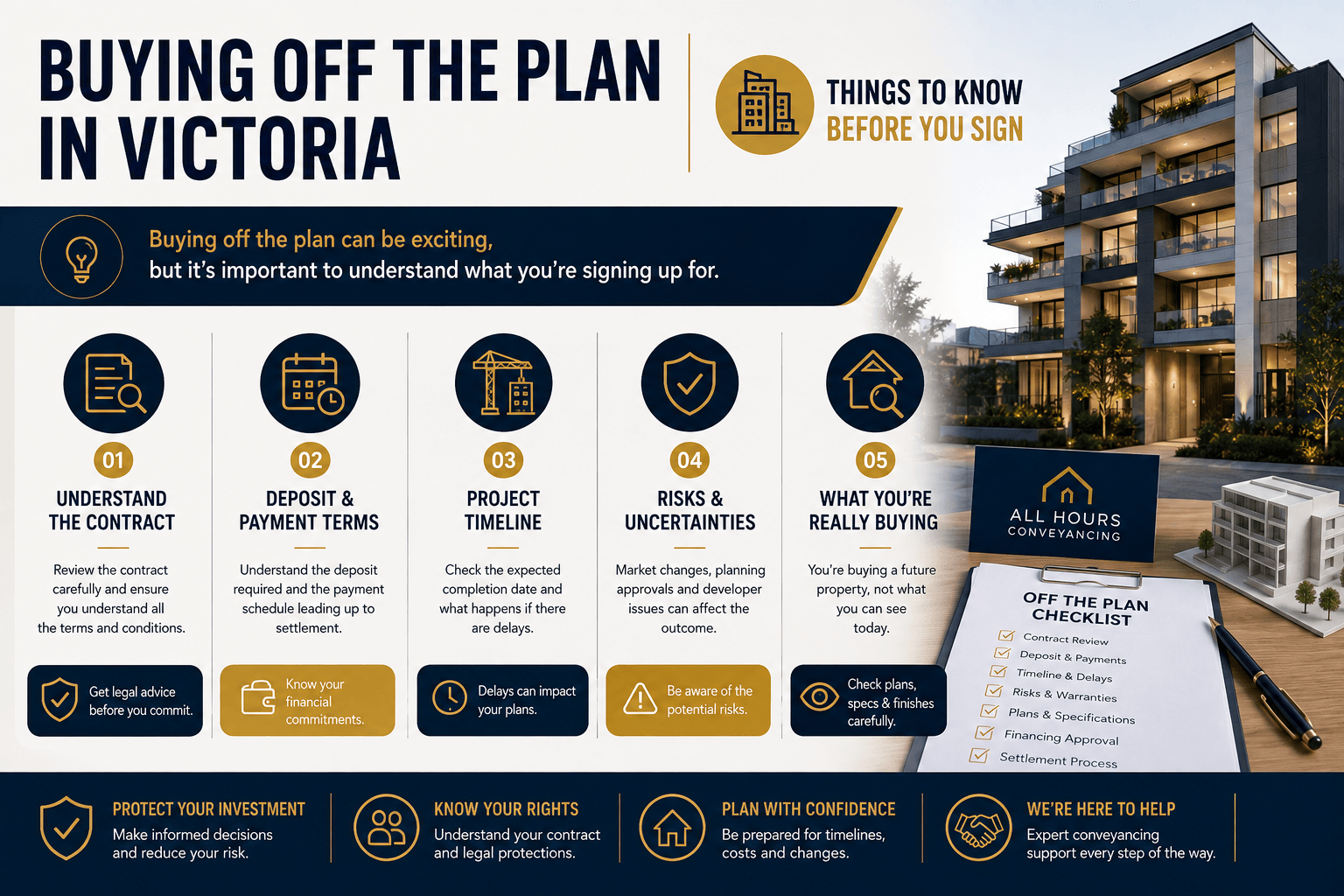
Off-the-plan property purchases in Victoria lock you into a contract for a home that does not yet exist. The contract price, deposit terms, and sunset clause all carry binding rights and obligations that differ from standard property sales. Buyers who overlook these Victoria-specific protections risk financial exposure that a standard purchase would never create.
This guide covers the things to know when purchasing an off the plan property in Victoria. From stamp duty concessions and financing risks to contract clauses that favour developers, each section addresses a specific decision point. The goal is to equip you with actionable knowledge before you sign anything.
All Hours Conveyancing has guided more than thousands of property transactions over 20 years since 2005, holds a 4.8 star rating from 129 Google reviews, and is led by Shakila Maclean, President of the Australian Institute of Conveyancers (Victorian Division).
How Off-the-Plan Purchases Work in Victoria
Buying off-the-plan in Melbourne and regional Victoria follows a distinct regulatory framework governed by the Sale of Land Act 1962. The contract must include a clearly visible warning notice disclosing deposit limits, time risks, and potential value changes. Victoria also restricts developers from invoking sunset clauses without written buyer consent or a Supreme Court order, a protection not uniformly available in other Australian states.
The deposit is capped at 10% of the contract price. If the plan of subdivision is not registered within the time specified in the contract, or the default period of 18 months where no time is specified, you can terminate and recover your deposit. Buyers also have a 3-business-day cooling-off period from date of signing when purchasing off the plan by private sale in Victoria, providing an early exit if needed.
What Does 'Off-the-Plan' Mean?
An off-the-plan property is a dwelling you commit to purchasing before construction is complete. Your buying decision rests on architectural plans, floor layouts, and developer specifications rather than a physical inspection of the finished product.
Key Advantages of Purchasing Off-the-Plan
Off-the-plan purchases in Victoria come with specific financial incentives that can save tens of thousands of dollars compared to buying an established property at the same price point.
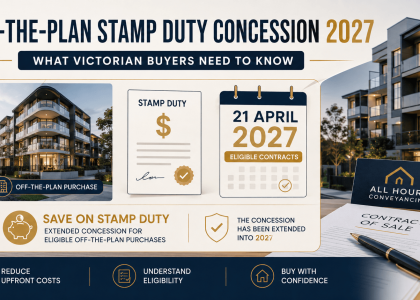
- Stamp duty savings: Victoria’s duty concession calculates stamp duty on the land value plus construction completed at contract date, not the full finished property value. Victoria has extended off-the-plan stamp duty concessions for eligible contracts entered into on or before 21 April 2027.
- First Home Owner Grant eligibility: The grant offers eligible buyers $10,000 for a new home valued at $750,000 or less. First home buyers may be exempt from stamp duty on homes valued up to $600,000.
- Price lock-in: The contract price stays fixed regardless of market movements during construction. If the market rises 8% over a 12-month build, you benefit from that capital growth without paying more.
- Customisation opportunity: Early buyers can select finishes, floor plans, and fixture brands. This turns an off-the-plan purchase into a semi-custom build.
- Extended saving window: You pay only the deposit at contract signing. Settlement fees, stamp duty, and the balance fall due when construction finishes, giving you months or years to build savings.
- Tax depreciation: New properties generate higher depreciation deductions for investors. This improves after-tax cash flow compared to established dwellings with minimal depreciable assets.
- Builders' warranty protection: Victoria's domestic building insurance covers structural and non-structural defects within specified timeframes after completion, with repairs required by the builder.
As a practical example, a first home buyer purchasing a $580,000 off-the-plan apartment in Melbourne’s inner suburbs could combine the $10,000 grant with a full stamp duty exemption. This saves over $40,000 compared to an equivalent established property. You can review first home buyer eligibility and grant details for the full breakdown of available concessions.
Loan to Value Ratio (LVR) and Financing Implications
Your loan to value ratio measures the percentage of the property’s value that you borrow. A $500,000 property with a $100,000 deposit produces an LVR of 80%. Lenders prefer lower LVR because it reduces their risk exposure.
Off-the-plan purchases create a unique LVR challenge. Banks issue conditional approval at contract signing but conduct a final valuation near completion. If the property’s market value drops below the contract price, your LVR rises. A property purchased at $550,000 that values at $500,000 on completion forces you to cover the $50,000 shortfall or pay Lenders Mortgage Insurance. Securing pre-approval early and avoiding new debt between signing and settlement are non-negotiable steps.
Important Risks and Considerations Before Purchase
Off-the-plan contracts are typically drafted to protect the developer. Every clause requires scrutiny because the risks compound over the months or years between signing and settlement.
- Sunset clauses: Every off-the-plan contract includes a sunset clause setting the deadline for development completion. If the developer misses this date, either party can terminate. In Victoria, the developer must obtain your written consent or a Supreme Court order before rescinding under the sunset clause. Without this protection, developers could deliberately delay, terminate, and resell at higher prices.
- Construction delays: Completion dates in off-the-plan contracts are estimates. Weather, labour shortages, material supply issues, and council approvals can push timelines by 6 to 18 months beyond projections.
- Developer insolvency: If the builder or developer goes bankrupt mid-construction, your deposit is at risk. Check whether deposits are held in a trust account and confirm the developer's financial history before signing.
- Material substitutions: Contracts typically allow developers to substitute materials and fittings with items of "equivalent quality." This clause permits the developer to swap your chosen kitchen brand for a cheaper alternative that technically meets the contract’s broad definition.
- Floor area variations: The finished property's floor area can differ from plans within a stated tolerance. A contract permitting a 5% tolerance on a 70sqm apartment allows delivery of a 66.5sqm dwelling with no recourse for the buyer.
- Unexpected costs: Body corporate fees, owners corporation levies, and special contributions are not always clear at contract signing. Request the projected annual costs and any planned capital works.
- Resale restrictions: Some contracts limit your ability to resell before settlement. Check whether assignment clauses exist and what fees apply.
Rental guarantees offered by developers often embed costs into the purchase price and expire after 12 to 24 months. Compare the guaranteed rent against comparable properties in the area to verify whether the post-guarantee rental income covers your holding costs. Contact the local council to check zoning and future developments near your off-the-plan property that could affect value or livability.
Research the developer’s track record before committing. Search the Building and Plumbing Commission (BPC), the regulator that replaced the Victorian Building Authority in 2025, for complaints against the developer. Request a list of completed projects and inspect them in person. Ask current owners about build quality, defect resolution timelines, and whether finishes matched the sales material.
Your contract should specify who bears responsibility for defects discovered at handover. Obtain written confirmation of the defect rectification process and timeframes before signing. The biggest risks in buying off the plan are the sunset clause, the developer’s right to vary the building, price versus valuation differences at completion, and construction delays.
Regional Differences and Buyer Tips
Victoria’s off-the-plan regulations differ from other states. The sunset clause protections, the three clear business day cooling-off period for private sales, and stamp duty concession calculations apply specifically to Victorian contracts and do not exist uniformly across Australia.
Body Corporate and Strata Considerations
- Apartment purchases include ongoing body corporate and strata fees covering building maintenance and insurance.
- Review the proposed owners corporation rules for pet restrictions and short-stay rental policies.
- Request estimated annual levies before signing.
Seeking Professional and Legal Advice
A conveyancer experienced in off-the-plan transactions reviews the sunset clause, variation clauses, floor area tolerances, plan of subdivision details, and duty concession eligibility. Off-the-plan contracts contain clauses that differ from standard property agreements, requiring specialised contract expertise.
When choosing a conveyancer, verify their experience with off-the-plan transactions specifically. Ask about their contract review process and approach to managing off-the-plan risks.
All Hours Conveyancing has coordinated off-the-plan transactions since 2005, has guided more than thousands of property transactions, holds a 4.8 star rating from 129 Google reviews, and is led by Australian Institute of Conveyancers (VIC) President Shakila Maclean.
Frequently Asked Questions
What are the risks of buying off the plan?
The main risks are construction delays, developer insolvency, material substitutions, and market value drops between signing and settlement. The finished property may not match your expectations in quality or layout. Floor area variations within contract tolerances can reduce your dwelling size. Market value drops can increase your LVR, forcing you to fund a shortfall. Have a conveyancer review every clause before you commit.
Do you pay stamp duty when buying off the plan in Victoria?
Yes, stamp duty applies to off-the-plan purchases in Victoria. The duty concession calculates the amount based on land value plus construction completed at contract date, not the full finished value. First home buyers purchasing properties valued at $600,000 or less qualify for a complete exemption. A tapered concession applies for properties valued between $600,001 and $750,000. Victoria has extended these concessions for eligible contracts entered into on or before 21 April 2027.
Is it worth buying off the plan?
It depends on your financial stability and the developer’s track record. Off-the-plan purchases deliver stamp duty savings, customisation options, and potential capital growth during construction. These advantages carry corresponding risks: construction delays, valuation shortfalls at settlement, and limited recourse if the developer substitutes materials. The value depends on how thoroughly your conveyancer reviews the contract.
How does buying off the plan work in Australia?
You sign a contract to purchase a property before construction finishes. A deposit of up to 10% is paid at contract signing. The balance is due at settlement once construction completes and the plan of subdivision is registered. Lenders issue conditional approval at signing but conduct a final valuation before releasing funds. Contracts include unique clauses such as sunset clauses and material variation provisions that do not appear in standard purchase contracts.
Is buying off the plan risky?
Yes, off-the-plan purchases carry measurable financial risks. Construction delays, developer insolvency, plan changes, and market value drops between signing and settlement create financial exposure. The finished property may differ from the marketing material in quality and floor area. Victoria’s sunset clause protections reduce one risk category, but careful contract review by an experienced conveyancer remains your strongest safeguard against the remaining risks.
Final Thoughts
Off-the-plan property in Victoria offers genuine financial advantages. Stamp duty concessions, first home buyer grants, and price lock-in during construction create opportunities that established properties cannot match.
The risks are equally real. Sunset clauses, developer variation rights, valuation gaps, and construction delays can erode your position if the contract is not reviewed by a qualified professional.
Before signing any off-the-plan contract in Victoria, engage a conveyancer who specialises in these transactions. Request a personalised fee proposal from All Hours Conveyancing to protect your interests from contract review through to settlement day.