Joint Tenants vs Tenants in Common: Understanding Your Options in Australia
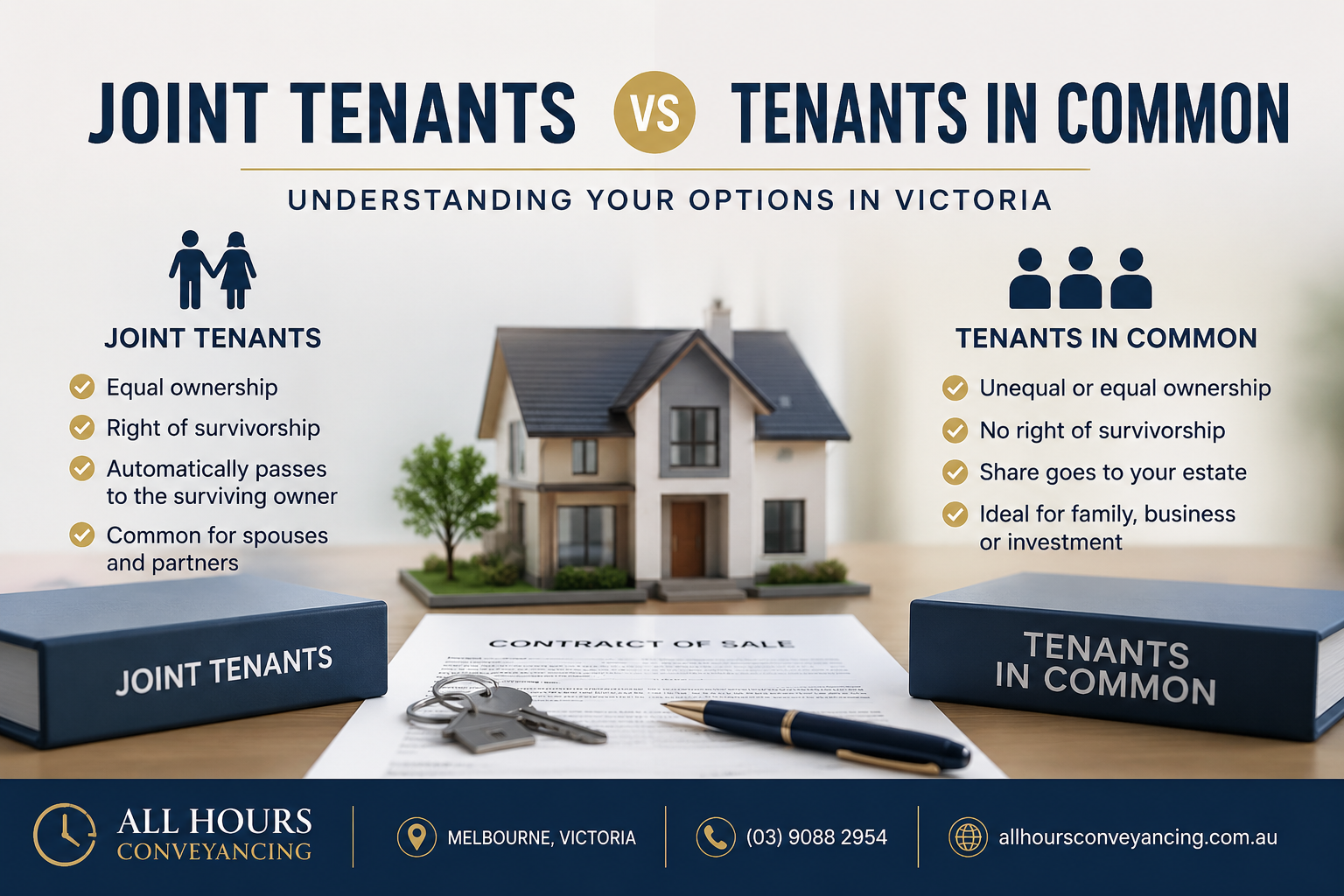
Your choice between joint tenants vs tenants in common shapes what happens to your property if a co-owner dies, separates, or wants out. For Melbourne buyers, this decision affects succession, tax obligations, and long-term control over your real estate co-ownership.
Victorian property contracts require you to nominate an ownership structure at the point of purchase. Changing it later costs time and money. Property ownership in Australia carries distinct legal consequences under each arrangement.
Why Property Ownership Structure Matters in Victoria
Victoria's land registration system records your ownership type on the property title at settlement. That single entry on the title determines whether your share passes automatically to a co-owner or flows into your estate upon death.
A licensed conveyancer reviews your contract and confirms the nominated structure under joint tenants vs tenants in common aligns with your financial goals and estate plans. Choosing the right professional is equally important-our guide to Different Types of Conveyancers in Melbourne explains the different options available and how to select the right one for your property transaction. The Lands Titles Office in Victoria processes all title registrations, and corrections after settlement require formal legal steps. Professional advice before you sign the contract prevents costly amendments later. All Hours Conveyancing offers contract review services to protect your interests at this stage.
How Joint Tenancy Works in Victoria
Joint tenancy is a form of co-ownership where each owner holds an equal, undivided interest in the property. No joint tenant can own a larger share than another. Couples frequently select this structure for its automatic right of survivorship. If one owner dies, the surviving owner absorbs the deceased's share without probate.
On community forums like Reddit's AusFinance, buyers consistently confirm this pattern. Community discussions consistently confirm that spouses value the simplicity of this arrangement for the property passing to the surviving partner without court involvement.
Key Advantages of Joint Tenancy
• Automatic survivorship: The deceased owner's share transfers to the surviving joint tenant through a survivorship application.
• Equal ownership by design: Each owner holds the same percentage, eliminating disputes over share size.
• Simplified estate administration: The property bypasses the deceased's estate entirely.
• No separate title transfer required: The surviving owner registers the death certificate on the title to become sole owner by way of Survivorship Application.
• Suited to long-term partners: Spouses and de facto couples gain certainty that the property stays with the survivor.
Process for Ending a Joint Tenancy
Ending a joint tenancy in Victoria converts the ownership to tenants in common. This process is called severance.
• Step 1: One or both parties instruct a licensed conveyancer to prepare a transfer of land document that severs the joint tenancy.
• Step 2: The conveyancer lodges the severance document with the Victorian Lands Titles Office.
• Step 3: The Lands Titles Office updates the title to reflect tenants in common ownership, typically in equal shares unless otherwise specified.
• Step 4: Both parties update their Wills to reflect the new ownership structure.
A professional conveyancer confirms the lodgement meets Victorian requirements. All Hours Conveyancing in Melbourne handles severance documentation and title registration for clients across Victoria.
What the Right of Survivorship Means for Joint Tenancy
The right of survivorship is the defining feature that separates joint tenancy from tenants in common. When a joint tenant dies, their interest does not form part of their estate.
The surviving joint tenant automatically receives the deceased's share by operation of law.The surviving owner registers the death on the property title by lodging a certified copy of the death certificate with the Victorian Lands Titles Office by way of Survivorship Application. Until registration occurs, the title still shows both names, but legal ownership has already passed to the survivor.
Your Will should still address the property. If both joint tenants die within 30 days, survivorship cannot operate. Victorian Wills should include a simultaneous death clause that directs how the property passes if neither owner survives the other. A conveyancer or estate planning solicitor can advise on appropriate wording for this scenario.
How Tenants in Common Arrangements Work
Tenants in common is a co-ownership structure where each owner holds a defined, separate share of the property. These shares do not need to be equal. One owner can hold 70% while the other holds 30%, reflecting their respective financial contributions. The distinction between tenants in common vs joint tenants in Victoria centres on two features: no right of survivorship and flexible share allocation.Two Melbourne-based scenarios illustrate how this works. Siblings Sarah and James purchase a townhouse in Brunswick. Sarah contributes $400,000 and James contributes $200,000. They register as tenants in common with a 67/33 split. Each can leave their share to their own children through their Will. In a second scenario, three friends co-purchase an investment property in Footscray. They hold as tenants in common with shares of 50%, 30%, and 20%. Each investor's share reflects their deposit contribution and forms part of their individual estate. As FindLaw explains, each tenant in common owns a share of the entire property rather than a specific physical portion of it. Discussions on Real Estate Investors Australia confirm that the key difference is how ownership and succession is structured.
Why Choose Tenants in Common?
• Unequal contributions recognised: Share ratios match each owner's financial input, preventing disputes over equity.
• Inheritance control: Each owner can Will their share to a nominated beneficiary rather than it passing automatically to the co-owner.
• Blended family protection: Parents in second marriages can direct their share to children from prior relationships.
• Investment flexibility: Multiple investors can enter and exit the arrangement by selling their individual share.
• No consent required for transfer: An owner can sell or transfer their share without the other owners' permission.
• Estate planning alignment: The share integrates with your broader estate plan, including trusts and superannuation nominations.
Ending a Tenants in Common Ownership
Each tenant in common can sell, transfer, or gift their share at any time. No consent from other co-owners is required for this action.
• Sell your share: List your defined share for sale to a third party or the existing co-owner.
• Buyout arrangement: One owner purchases the other's share to dissolve the arrangement entirely.
• Court-ordered partition: If co-owners disagree, a court can order the property sold and proceeds divided.
Melbourne conveyancers prepare the transfer documents through Survivorship Application and lodge them with the Lands Titles Office. All Hours Conveyancing manages property transfers across all ownership structures in Victoria.
Comparing Joint Tenancy and Tenants in Common
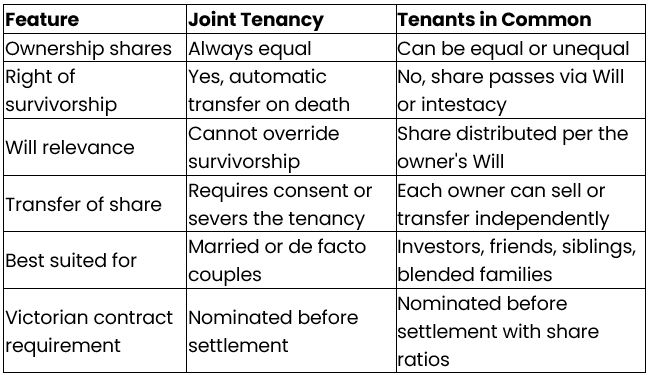
Joint tenants hold equal shares with the right of survivorship, while tenants in common hold defined shares without survivorship. The table below summarises the key differences.
When selecting between these structures, evaluate whether automatic survivorship or flexible share allocation better serves your estate and financial goals.
Speak to an Expert for Personalised Guidance
Your property ownership advice should come from a professional who understands your specific financial position, family structure, and long-term goals. A licensed Melbourne conveyancer reviews your contract, explains the implications of each ownership type, and verifies the title registration matches your intentions. Contact All Hours Conveyancing on 03 9649 7832 to discuss your options before signing.
This article provides general information about property co-ownership structures in Victoria. It does not constitute legal or financial advice. Your individual circumstances require professional guidance from a licensed conveyancer or solicitor who can assess your situation directly.
Inheritance and Succession: Death of an Owner
The ownership structure you select directly controls what happens to your property share when you die. Under joint tenancy, your interest passes to the surviving co-owner automatically. Under tenants in common, your share enters your estate and passes according to your Will or intestacy laws.
A blended family in Melbourne's eastern suburbs shows the difference clearly. David and Karen are married, each with children from previous relationships. If they hold their Hawthorn home as joint tenants and David dies, Karen receives the entire property. David's children from his first marriage inherit nothing from the property, regardless of what his Will states. If David and Karen instead hold as tenants in common with 50/50 shares, David can direct his 50% to his children through his Will. He can include a clause granting Karen the right to reside in the property. Tenants in common vs joint tenants in Victoria produces dramatically different inheritance outcomes for families with complex structures.
Considerations Around Land Tax and Compliance
Victorian land tax calculations changed in recent years. The State Revenue Office now aggregates the total taxable value of all land owned by each individual across Victoria. This means your ownership structure affects your land tax threshold and liability.Tenants in common arrangements carry distinct land tax consequences. If you hold a 30% share as a tenant in common, the SRO attributes only that 30% of the site value to your personal landholding assessment. This can reduce your individual land tax bill compared to joint tenancy, where ownership is treated as equal and undivided. Investors purchasing multiple properties should model both structures against current Victorian land tax rates before signing the contract. If you're purchasing your first investment property, understanding the ownership structure from the outset can help you minimise future legal and tax complications. Read our guide on Buying Your First Investment Property for practical tips before making your purchase. Your conveyancer and tax adviser should coordinate for compliance and structuring.
The Value of Professional Legal Support
Property transfers, contract negotiations, and succession planning require professional guidance that goes beyond a standard online search. A licensed conveyancer identifies risks in your contract. If you're unsure whether you need a solicitor or a conveyancer, our article Should I Use a Solicitor or a Conveyancer? Key Differences Explained outlines the roles of each professional and when each may be appropriate. All Hours Conveyancing brings over 30 years of combined experience to these decisions.
Succession planning intersects directly with your choice of ownership structure. Each time you buy or sell property, your estate plan should be reviewed. A conveyancer who understands Victorian property law can flag when your ownership type conflicts with your Will provisions. The cost of professional estate planning legal help at the purchase stage is a fraction of what litigation costs later.
Choosing how you own a property is only one of several important decisions you'll make before settlement. Buyers should also understand the legal protections available after signing a Contract of Sale, particularly the differences between the cooling-off period and a finance clause. Our article on Joint Tenants vs Tenants In Common Victora explains how these protections work and when they can help you withdraw from a property purchase.
Final Thoughts on Choosing Joint Tenants or Tenants in Common
Your property ownership structure is not a formality. It determines who inherits your share, how land tax applies, and what options you retain if circumstances change. Joint tenancy suits couples who want automatic survivorship and equal ownership. Tenants in common serves buyers who need flexible share allocation and independent control over inheritance.
The right choice depends entirely on your relationship, financial contributions, family structure, and long-term estate goals. A qualified Melbourne conveyancer can assess your situation and confirm your contract reflects the structure that protects your interests. Contact All Hours Conveyancing on 03 9649 7832 to discuss joint tenants vs tenants in common before your next property purchase.