Cost of Conveyancing: Detailed Fee Breakdown, Who Pays & Price Expectations
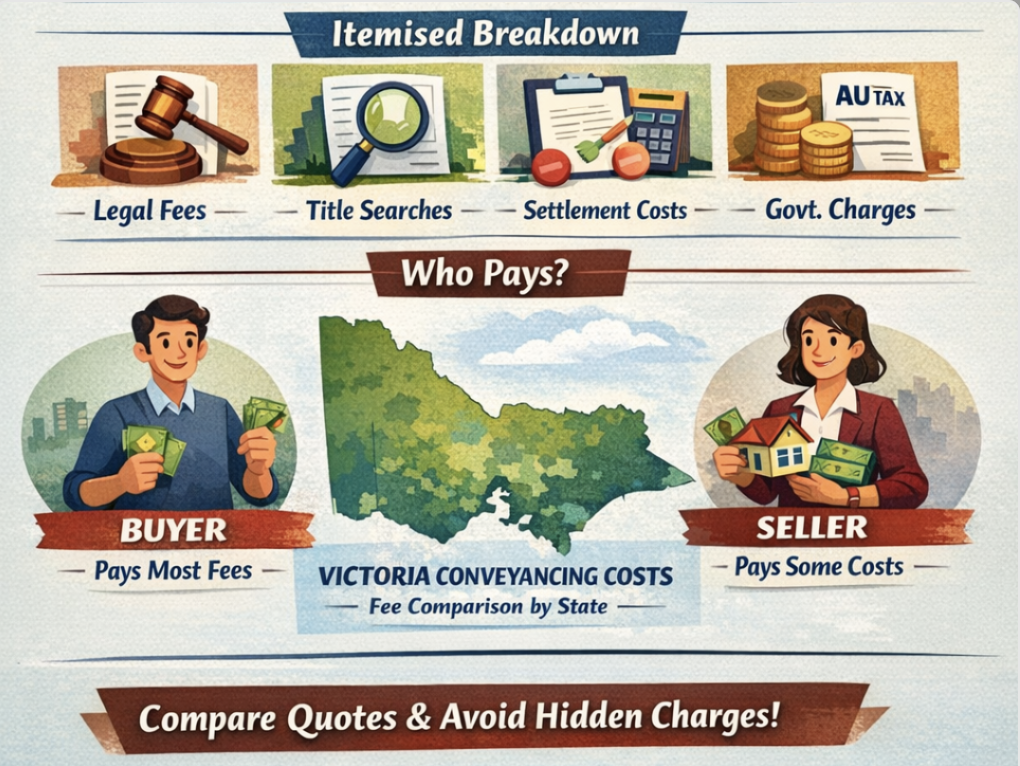
The cost of conveyancing in Australia ranges from $400 to $3,800 depending on transaction complexity, property type, and your state or territory. That spread catches most buyers and sellers off guard, and vague quotes only make it worse. Conveyancing fees sit between $1,000 and $2,000 for professional service charges alone, while disbursements add another $600 to $800 on top. Without an itemised breakdown, you are comparing apples to oranges when shopping for quotes. Transparent conveyancing pricing protects you from hidden charges at settlement. This guide covers every fee component, who pays what, and how fees for conveyancing compare across Victoria.
Understanding Conveyancing in Property Transfers
Conveyancing is the property transaction legal process that transfers legal ownership of real estate from one party to another. It covers everything from contract preparation through to title transfer and settlement, making sure the transaction complies with state-specific legislation.
Errors in this legal framework carry severe financial consequences, from losing deposits to acquiring a property with undisclosed encumbrances. A qualified conveyancer acts as your risk shield, verifying title accuracy, confirming compliance, and coordinating the fees for conveyancing so nothing falls through the cracks before settlement day.
What Does a Conveyancer Do in Your Property Journey?
A conveyancer identifies risks in the contract review process and negotiates terms on your behalf, covering legal, financial, and administrative steps from contract signing through to settlement.
- Contract review and negotiation of special conditions, cooling-off clauses, and settlement terms
- Settlement coordination with banks, the opposing party's legal representative, and government registries
- Title and property searches to uncover encumbrances, easements, or planning restrictions
- All-hours support at milestones like finance approval deadlines and auction day
Key Tasks Performed by a Conveyancer
- Prepare, lodge, and verify legal documents including the contract of sale and transfer of land
- Conduct title searches and advise on title insurance options to protect against hidden defects
- Manage digital settlements through PEXA, the electronic platform used across Australian states
- Calculate settlement adjustments for council rates, water, and owners corporation fees
- Advise on regulatory updates such as smoke alarm compliance, pool safety certificates, and owner builder disclosure rules
- Handle contract negotiation with the other party's representative when special conditions need amending
What Are the Average Fees for Conveyancing Services?
The average fees for conveyancing in Australia fall between
$1,000 and $2,000 for professional charges. Most quotes exclude disbursements, which typically add $600 to $800. To estimate conveyancing fees accurately, you need an itemised quote that separates the fixed service fee from third-party costs. A quote showing a single lump sum with no line items is a red flag. For example, a $1,200 quote that bundles everything looks cheaper than a $900 quote plus $400 in disbursements, but the second option actually costs less.
Transparent quoting means every charge is listed: professional fee, GST inclusion or exclusion, PEXA fees, search fees, and any conditional extras like auction contract review. How much should conveyancing cost for your specific situation? Ask for a personal, itemised breakdown before committing. Providers with
professional indemnity insurance and fixed fee structures give you the most budget certainty, as their legal fees conveyancing will not shift mid-transaction.
Who Pays Conveyancing Fees in a Property Sale or Purchase?
Both sides of a property transaction engage separate conveyancers, and each party covers their own costs. Who pays conveyancing fees is clear in most cases:
- Buyers pay their own conveyancer's professional fee, all property searches, stamp duty preparation, and lender liaison costs
- Sellers pay their own conveyancer's professional fee, contract preparation costs, and settlement discharge fees
- Buyer responsibilities are higher with more searches, compliance checks, and lender coordination required
- Seller responsibilities are typically lower, but contract preparation and vendor disclosure obligations still carry cost
What Do Conveyancing Fees Include and Exclude?
A fixed-fee conveyancing quote should cover all professional work from contract to settlement. Disbursements and third-party charges are almost always extra. Here is what to check:
- Typically included: contract review, document preparation, settlement attendance, communication with the opposing party, and regulatory compliance advice
- Typically excluded: disbursements such as title searches, council and planning certificates, PEXA transaction fees, and land registry charges
- Often unclear: GST inclusion or exclusion, fees for additional correspondence beyond standard scope, and charges for reviewing auction contracts
- Excluded items to ask about: stamp duty calculation services, special condition drafting, and post-settlement follow-up with council for ownership notification
Why Buyers Pay More in Conveyancing Fees Than Sellers
| Fee Component |
Buyer |
Seller |
| Property and title searches |
Yes (multiple searches required) |
No |
| Stamp duty preparation |
Yes |
No |
| Lender liaison |
Yes (if mortgaged) |
Discharge only |
| Risk checks and compliance |
Extensive |
Limited |
| Typical fee range |
$900 to $2,500+ |
$600 to $1,500 |
Essential Questions to Compare Conveyancing Fees & Services
Choosing a conveyancer based on price alone leads to scope gaps and surprise invoices at settlement. These questions force transparency and let you compare conveyancing solicitor fees on equal terms. Solicitor fees for conveyancing often include broader legal scope, so confirm what each quote covers.
- Is your quoted fee fixed, and does it include GST?
- What disbursements will I pay on top of the professional fee, and can you itemise them now?
- Do you charge extra for auction contract review, after-hours communication, or additional correspondence?
- What is your professional indemnity insurance coverage?
- How many property settlements has your team completed in the past 12 months?
Key Questions to Ask About Conveyancing Fees
- Are there any circumstances where the fixed fee changes mid-transaction?
- Do you handle digital settlements through PEXA, and is the PEXA fee included?
- What searches do you conduct for buyers, and which are optional versus mandatory in my state?
- How do you communicate progress, and how quickly do you respond to client queries?
- Are you a member of the Australian Institute of Conveyancers or an equivalent professional body?
- Can you provide a written breakdown of all expected costs before I commit?
Should You Use a Conveyancer or Solicitor for Your Property Settlement?
| Criteria |
Licensed Conveyancer |
Solicitor |
| Specialisation |
Property law only |
All areas of law |
| Typical fee range |
$800 to $2,000 |
$1,500 to $3,000+ |
| Best for |
Standard residential purchases and sales |
Complex matters: disputes, trusts, commercial |
| Professional body |
Australian Institute of Conveyancers |
Law Society or Bar Association |
| Conveyancing solicitor fees |
Lower with focused scope |
Higher with broader qualifications |
For a standard residential transaction, a conveyancer with dedicated property experience delivers the best value. A firm like
All Hours Conveyancing, with 20 years of experience in Melbourne, combines specialist focus with deep market knowledge. Reserve solicitors for matters involving trustee arrangements, property portfolio restructuring, or cross-border legal issues. If you need a
contract reviewed before auction day, a specialist conveyancer can provide prompt, focused advice.
When in the Sales Process Are Conveyancing Fees Applicable?
Engage your conveyancer
before signing any contract. The best time is when you shortlist properties or prepare to list for sale. Waiting until after exchange limits your conveyancer's ability to negotiate conditions, review clauses, or flag risks. Fees for conveyancing apply from the point of engagement through to settlement completion, with most providers invoicing at settlement. Whether you are
selling or buying, early engagement protects your interests.
Key Stages When Conveyancing Fees Apply
- Pre-offer: contract review, due diligence advice, and auction contract preparation
- Post-signing: searches, finance condition management, and compliance checks
- Pre-settlement: adjustment calculations, PEXA workspace preparation, and final document verification
- Settlement day: funds transfer coordination, title registration, and council notification
Need Further Clarity on Conveyancing Fees?
Whether you are a first-home buyer in Melbourne, selling an investment property, or handling an off-the-plan purchase, get a quote suited to your situation. Contact a property conveyancer who provides obligation-free, itemised quotes that list every fee and disbursement upfront.
Contact Details for Your Local Conveyancing Expert
All Hours Conveyancing: Level 1, 530 Little Collins St, Melbourne VIC 3000 | 03 9649 7832
Related Property Fees & Finance Guides
Expand your property knowledge with these related property guides and fees for conveyancing resources:
Can You Have Multiple Offset Facilities for Your Home Loan?
- Learn how multiple offset accounts can reduce your mortgage interest and accelerate equity growth.
Should You Use an Offset Facility or Pay Off Your Mortgage Early?
- Compare the financial outcomes of offset strategies versus lump-sum mortgage repayments.
How to Pay Off Your Mortgage Faster: Tips to Becoming Mortgage Free
- Actionable strategies for reducing your loan term and total interest paid.
Frequently Asked Questions About Conveyancing Fees
Are conveyancers cheaper than lawyers?
Yes. Licensed conveyancers charge
$800 to $2,000 for standard residential transactions, while solicitors typically charge $1,500 to $3,000 or more. The difference reflects scope: conveyancers specialise in property transfers, while solicitors carry broader legal qualifications that most residential transactions do not require.
Is it better to use a conveyancer or solicitor?
A licensed conveyancer is the right choice for standard residential buying or selling. They offer property-specific expertise at a lower price point. Choose a solicitor only when your transaction involves disputes, complex trust structures, or commercial legal issues that exceed a conveyancer's licensed scope.
Who pays for conveyancing fees?
Each party pays their own conveyancer. The buyer engages and pays a conveyancer for buyer-side work (searches, stamp duty, lender coordination). The seller does the same for contract preparation and settlement discharge.
How much does conveyancing cost?
Total conveyancing costs combine professional fees ($1,000 to $2,000) and disbursements ($600 to $800). If you are buying and selling simultaneously, you will pay two sets of fees. Property type, state legislation, and transaction complexity all influence the final figure.
Do you pay conveyancing fees when buying or selling a property?
Yes, conveyancing fees apply to both buying and selling. They apply to transfers of equity, subdivisions, and remortgages. Most conveyancers invoice at settlement, though some request a deposit or progress payments for extended transactions.
What is the difference between conveyancing fees and conveyancing costs?
Conveyancing fees refer specifically to the professional service charge your conveyancer quotes for their work. Conveyancing costs encompass the total outlay, including fees plus all disbursements such as search fees, PEXA charges, and government registration costs.
How much does conveyancing cost in 2025?
In 2025 and into 2026, Australian conveyancing professional fees remain between $1,000 and $2,000 for most residential transactions. Total costs including disbursements typically range from $1,600 to $2,800. Fees trend upward in states with more regulatory requirements or fewer competing providers.
How do disbursements impact the total cost of conveyancing?
Disbursements are third-party charges your conveyancer pays on your behalf for property searches, government certificates, PEXA settlement platform fees, and land registry filings. They are not included in the base professional fee and add
$600 to $800 to your total bill. Always request a disbursement estimate before engaging a provider.
Can I get a fixed conveyancing fee?
Many conveyancing firms offer fixed-fee arrangements that cover all standard professional work from contract to settlement. Confirm in writing what the fixed fee includes, whether GST is built in, and under what circumstances additional charges could apply. Disbursements are almost always extra even with a fixed fee.
Are legal fees for conveyancing tax deductible?
Legal fees for conveyancing when purchasing your own home are generally not tax deductible. If you are purchasing an investment property, conveyancing costs form part of the cost base for capital gains tax purposes. Consult a registered tax adviser for guidance specific to your situation.
Summary
The cost of conveyancing depends on your state, transaction type, and the provider you choose. Professional fees between $1,000 and $2,000 are standard, with disbursements adding $600 to $800. Buyers consistently pay more than sellers. The single most effective step you can take is requesting itemised quotes from multiple providers, then comparing them line by line. Ask every question on the checklist above before signing an engagement letter. Compare conveyancing fees today and move forward with confidence that every dollar is accounted for.